We Are Training Ourselves to Talk Like Machines
· Thoughts
Originally published on LinkedIn
Part 1
To get better results from generative AI, you have to change the way you think. The way you ask. The words and phrases you use. Garbage in, garbage out, as they say. The better you become at getting AI to give you what you need, notice how it changes the way you speak to people.
I surely did.
I learned to strip the clutter. Drop the softening. Stop asking and start directing. Clarity is the name of the game. Clarity gets results and politeness gets noise. I optimise because optimisation is what AI rewards. And it works. My outputs improve, my thinking sharpens, and the habit quietly becomes my default.
I used to say please and thank you to AI. "ChatGPT, please research the SDGs and Malaysia's progress." I learned it was not only unnecessary. It was environmentally unfriendly. Every extra word requires processing, which requires energy, which means more carbon emissions and more water usage.
So I stopped. And then I noticed I was stopping elsewhere too. I had adopted AI-speak and I was using it on people, and they were noticing.
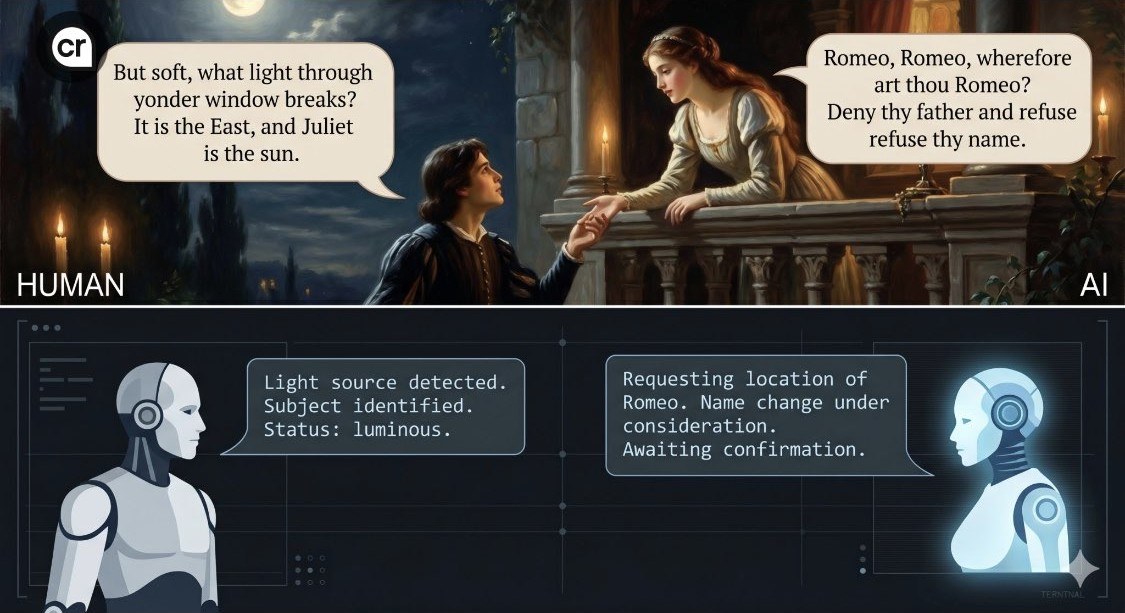
Shakespeare wrote:
But soft, what light through yonder window breaks? It is the East, and Juliet is the sun.
And Juliet answered:
Romeo, Romeo, wherefore art thou Romeo? Deny thy father and refuse thy name.
The AI version:
Light source detected. Subject identified. Status: luminous. Requesting location of Romeo. Name change under consideration. Awaiting confirmation.
One is two people reaching across the dark for each other.
The other is a helpdesk ticket.
Part 2
One could argue the helpdesk ticket is clearer and will yield better results. But no one can argue that Shakespeare's version doesn't sound more epic.
This is not about being rude. It is about what sustained optimisation does to instinct. We are training ourselves, efficiently, invisibly and maybe unconsciously, to communicate like machines because we are dealing with machines. And we won't realise how far it has gone until someone tells us we've changed.
You have probably already been changed. You just haven't noticed yet.
Spend a solid hour with AI. Then speak to the next person immediately after. Notice what comes out.
I would love to hear what you find. And someone should probably write a PhD on this.
These are my personal thoughts. They do not represent the views of any organisation I work for or advise.
Reza
Make Everything A Learning Experience